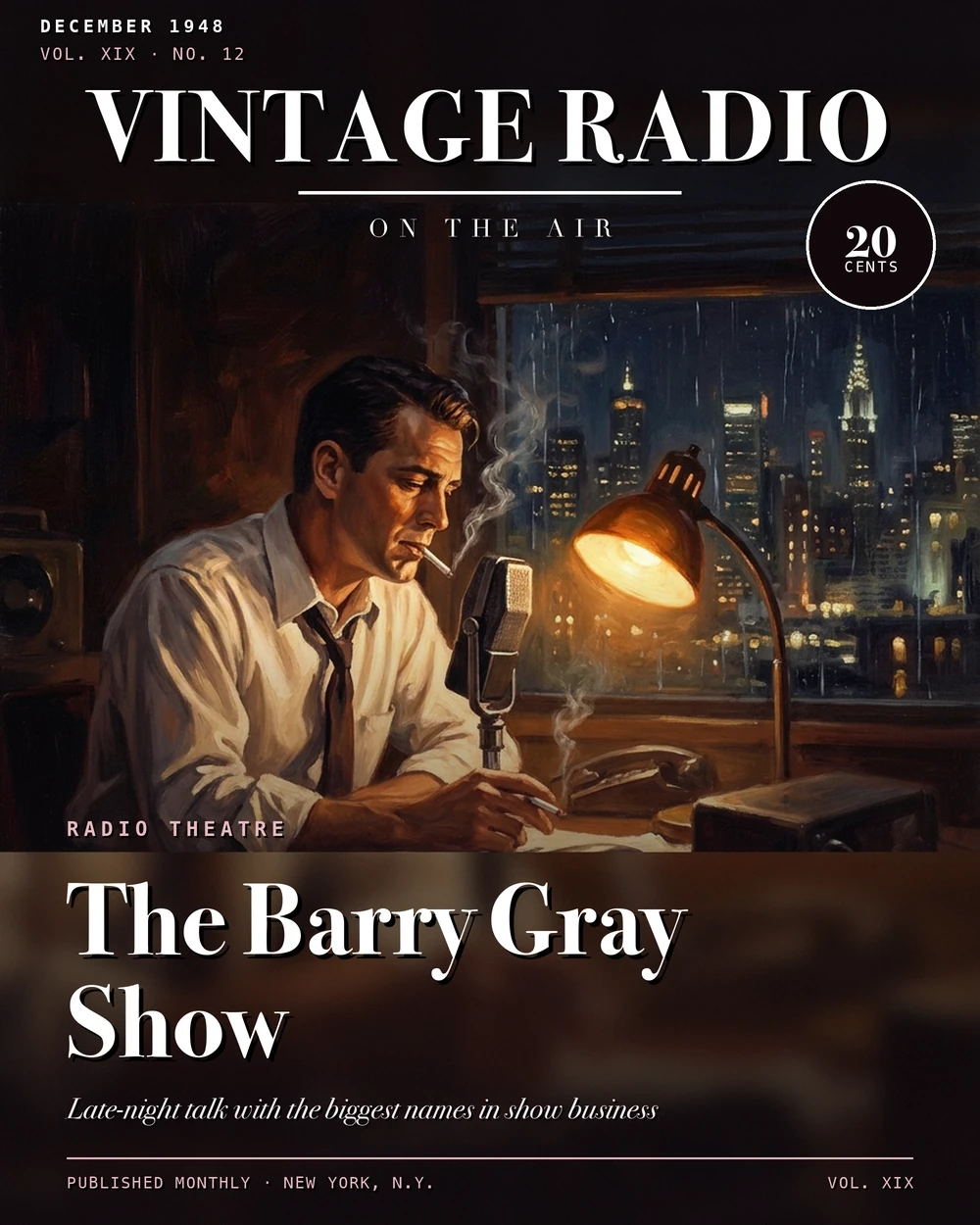
The Barry Gray Show
The Man Who Invented Talk Radio
Before the talk-radio format had a name, Barry Gray was doing it on the overnight shift at WOR-AM in New York City. Born Bernard Yaroslaw on July 2, 1916, in Red Lion, New Jersey, to Ukrainian Jewish immigrant parents, Gray came to WOR in 1945 hosting a late-night program called Moonlight Savings Time at $175 a week. The format changed permanently one night when bandleader Woody Herman happened to call the station while Gray was talking about him on air. Gray put the call through live. Listeners responded immediately, station management took notice, and the modern talk-radio format was effectively born from that single spontaneous phone conversation.
The show that grew from those WOR nights — the one captured in the six surviving episodes cataloged here, with a first recorded broadcast of October 27, 1946, and a last of October 14, 1949 — combined interviews, music, live performances, and topical discussion in a mix that had no clean predecessor. The New York Times television critic Jack Gould described it as "a nightly kaffeeklatsch which frequently adds up to extraordinarily different and distinctive radio." That description holds up. It was looser than a variety program, more wide-ranging than a straight interview show, and more willing to engage with current events and controversy than almost anything else on late-night radio at the time.
The Guests and What They Talked About
The six surviving episodes give a clear sense of how wide Gray cast his net. Al Jolson appeared, riding the wave of his career resurgence following the 1946 film The Jolson Story. Milton Berle was already a major entertainment figure before television made him a household name. Comedian Victor Moore, a veteran of both stage and screen, brought a different register — older show business, vaudeville-adjacent. Canada Lee, a pioneering African-American actor who had starred in the original Broadway production of Native Son and in Alfred Hitchcock's Lifeboat, appeared alongside Mac Clark. Adam Clayton Powell Jr. — then representing Harlem in the U.S. House of Representatives, the first African-American congressman elected from New York State — came on to discuss politics and civil rights at the national level.
One episode title, "Barry Went To See Death Of A Salesman," puts the show squarely in the New York cultural moment of early 1949, when Arthur Miller's play had just opened at the Morosco Theatre on February 10th of that year. The episode is a reminder that Gray treated contemporary theater as fair territory for late-night conversation, not just celebrity chat.
What connected these guests was Gray's approach. His hosting style created a relaxed atmosphere that let people talk rather than perform — which, in the late 1940s, was not how radio interviews typically worked. The listener call-in element added another layer, making the audience a participant rather than a passive receiver.
Why the Show Ended — and What Came Next
The WOR run did not end on Gray's terms. Sponsors found the show too controversial, and it was dropped in the late 1940s. Gray had also been broadcasting for WMGM from the Copacabana nightclub and, in the fall of 1948 into 1949, on WMIE-AM from three Miami Beach nightclubs. He returned to New York and joined WMCA in 1950, where he stayed for 39 years, continuing to develop the talk format he had pioneered at WOR.
The controversy never really went away. Gray was a fierce and public critic of bigotry, and right-wing columnist Walter Winchell spent years targeting him — calling him "Borey Pink" and "a disk jerk." Their feud became one of the more documented running battles in American broadcasting. Gray wrote about it, and much else from his career, in his 1975 autobiography My Night People.
His long-term standing in the field was eventually formalized: Talkers Magazine ranked him the eighth greatest radio talk-show host of all time in 2002, and in 2021 he was inducted into the Radio Hall of Fame. He died on December 21, 1996, in New York City.
The six episodes preserved from the WOR years are a small but direct window into the moment when the format was being invented — before it had imitators, before it had conventions, when Gray was simply figuring out what late-night radio could do if you pointed a microphone at interesting people and let the conversation go where it went.